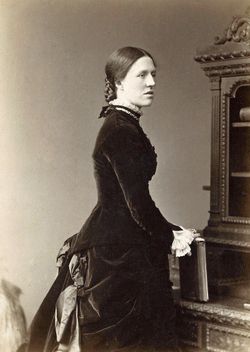
 Mary Kathleen Lyttelton (née Clive; February 27, 1856 – January 12, 1907) was a prominent British activist, writer, and editor dedicated to women's suffrage and social
reform.
Mary Kathleen Lyttelton (née Clive; February 27, 1856 – January 12, 1907) was a prominent British activist, writer, and editor dedicated to women's suffrage and social
reform.Queer Places:
St John the Baptist Churchyard, Hall Dr, Hagley, Stourbridge DY9 9LG, United Kingdom
Mary Kathleen Lyttelton (née Clive; February 27, 1856 – January 12, 1907) was a prominent British activist, writer, and editor dedicated to women's suffrage and social
reform.
Born in Belgravia, London, to judge and Liberal politician George Clive and Ann Sybella Martha Farquhar. In 1880, she married the Hon. Arthur Lyttelton, a tutor and later the first master of Selwyn College, Cambridge. The couple had three children: Margaret Lucy, Archer Geoffrey, and Stephen Clive.
Alongside her husband, she lived in Cambridge while Selwyn College was established. She co-founded the Cambridge Association For Women's Suffrage (CAWS) with Millicent Fawcett in 1884 and was active in the Cambridge Women’s Refuge and local literacy efforts for disadvantaged girls.
After moving to Lancashire in 1893 when her husband became a vicar, Kathleen co-founded the Manchester and Salford Women’s Trade Union Council (serving as executive committee chair), launched the Eccles branch of the Cooperative Women's Guild, and acted as a Poor Law Guardian.
Later in life, she worked as the editor of the women's supplement for The Guardian, authoring works such as Women and their Work (1901) and giving early publishing commissions to Virginia Woolf. She passed away suddenly from influenza and heart weakness on January 12, 1907.
In 1890, Kathleen Lyttelton and her close friend Louise Creighton founded the Ladies Dining Society in Cambridge.
It was a private discussion and dining club composed of twelve prominent women connected to the university community.
The group strongly advocated for women's education (specifically campaigning for women to be granted Cambridge degrees) and female suffrage. Its members included notable figures such as Eleanor Sidgwick, Mary Paley Marshall, Caroline Jebb, and Ida Darwin.
Operating until 1914, the society provided a crucial intellectual network and platform for women's public and political voices during a period when they were largely excluded from mainstream university governance.
The connection between The Honorable Lavinia Talbot (née Lyttelton) and Kathleen Lyttelton is primarily through family and shared circles of prominent Victorian women dedicated to education and social reform:
Lavinia was born the daughter of George Lyttelton, 4th Baron Lyttelton. Kathleen became part of the extended Lyttelton family through her marriage in 1880 to the Hon. Arthur Temple Lyttelton—who was Lavinia's younger brother (making Lavinia her sister-in-law).
Both women were prominent figures of their era who channeled their energies into expanding rights, educational access, and public roles for women. While Lavinia Talbot became well-known as a promoter of women's education and a co-founder of Lady Margaret Hall, Oxford, Kathleen Lyttelton focused heavily on women's suffrage, academic/trade networks in Cambridge and Lancashire, and journalism.
References:
Support this project
This website is a passion project researched, developed, and funded entirely by me. If you find the content valuable and would like to help support the ongoing research and hosting costs, any contribution is deeply appreciated.
Thank you for keeping this independent resource alive!
My books on Amazon: Elisa Rolle's books